Former FBI Director James Comey tells Spybrary's Bruce Dravis how a real Russian intelligence operation helped inspire Red Verdict, and discusses FBI tradecraft, espionage prosecutions, graymail and the spy writers he admires.
Unlike most espionage fiction, where the focus tends to be on the characters who betray confidences and those who try to stop them, Red Verdict goes further, to describe the prosecutorial clean-up required after the villainy is foiled.
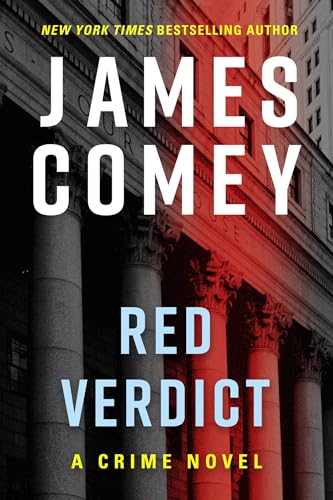
Written by former FBI Director James Comey, Red Verdict opens with a Russian spy ring using Novichok to murder the chief financial officer of a defense contractor, pressuring the firm’s already-compromised CEO to turn over defense and industrial information. The presence of a known Russian nerve agent as the murder weapon brings the FBI into the case.
In Red Verdict, the scenes of intrigue and tradecraft are presented from the perspective of both the spies and the FBI agents working the case. While the CEO and his Russian handlers are free to concentrate on not being caught, the FBI teams must not only uncover the plot, they must also develop the evidence of the crimes while remaining mindful of the legal and ethical constraints required for the evidence to withstand challenge in court. Catching the bad guy is only half of the battle.
In one key sequence, the CEO takes the FBI team on a cat and mouse chase through Manhattan’s streets and subways, succeeding in a particularly clever dead drop. The spy’s surveillance detection route features in a pivotal scene at trial, as does the presentation of the prosecution’s accumulated incriminating detail on such arcana as Russian electrical wiring, paint matching, and the dates appearing on American currency.
Comey served as US Attorney (lead federal prosecutor) for the Southern District of New York, Assistant Attorney General of the United States, and then joined the Lockheed Martin as senior vice president and served as Hertog Fellow at Columbia Law School. He was appointed as FBI Director in 2013 and terminated by Donald Trump in 2017. During his public service Comey supervised counter-intelligence cases, FBI investigations, and money laundering cases, which can sometimes have counter-intelligence aspects.
In 2023, Comey began a series of legal thrillers starring federal prosecutor Nora Carleton and her investigator Benny Dugan, who take on mobsters, high finance crime, and political extremists. For Red Verdict, the fourth book in the series, Comey turns to spies.
In my interview with Comey, he not only reveals that Red Verdict’s fiction has its origin in fact, but provides a citation to the case.
What should prospective readers know about Red Verdict?
It’s both a spy novel and a legal thriller that tries to show readers the way things really are in cases like this.
Red Verdict involves a tech CEO who is compromised by the Russians. One of your prior books, FDR Drive, is about domestic extremists. This gives them both a “ripped from the headlines” quality. Do you enjoy writing about contemporary themes?
Yes, I want to write things that readers will find interesting, and I also want to write about things I care about.
In your public service you handled counterintelligence and also money laundering cases. How many of the scenes in your work are inspired by actual incidents that you encountered?
I take actual cases and people I’ve known and use them as building blocks for fictional stories. My goal is to take readers inside these worlds to give them a real sense of the people and the problems they face.
Was there a real world case that served as an inspiration for Red Verdict?
Yes, for Red Verdict, I used a real life case the government declassified when I was FBI Director, where we had an undercover agent pretend to be interested in becoming a Russian spy. To test him, the Russians asked for some documents from his work and he gave them the documents—in a notebook with a tiny recorder hidden in the spine. The Russians took the notebook inside a secure room at their embassy to talk about the recruitment and we recorded every word. They then returned the notebook to the undercover, because he insisted it couldn't go missing from work or he would be exposed, and we got the tape, which was gold.
[A report on the case can be found at https://www.theguardian.com/us-news/2016/mar/10/fbi-infiltrated-russian-spy-ring-evgeny-burkyakov-prosecutors-say]
How did you come to write fiction after your departure from public service?
I got nudged into trying it by my agents, who thought I could do it well and would enjoy it. I doubted both of those things, but gave it a shot and realized that I loved it and I could use fiction to show people worlds I have known.
At one point in Red Verdict, the prosecutors worry that the defense will attempt to use a “graymail” stratagem. Can you please describe that for readers of this interview? Did you ever encounter graymail in cases you handled, and if so, how did you get past it?
The term was coined in the 1970s to describe a defense technique where a bad guy thwarts the government by forcing investigators to choose between prosecuting a crime like espionage and protecting secrets that would otherwise come out at a trial. Congress responded by passing a statute that lets judges supervise a process where a defendant can put on a defense but without being able to expose the government secrets. That statute, the Classified Information Procedures Act, effectively ended graymail.
Most espionage fiction deals with uncovering and foiling whatever the bad guy is doing. In Red Verdict, the protagonists not only have to find and stop the villain, but they have to ensure that they develop evidence that can be presented at trial. Can you speak to the importance you place on your protagonists working through the legal and ethical obligations they face?
In Red Verdict, I want readers to see how the government uses the criminal process to deal with espionage. It’s tricky and exciting and a very real part of the counterintelligence world. Because the work is exciting, I hope my books will hold attention while also showing the real-life problems lawyers and investigators face.
Spy novels often feature characters who operate outside the law. Do you ever get the urge to write a protagonist who operates without the constraints Nora Carleton and your other characters face?
I don’t. A lot of fiction writers use a “rogue” actor to generate excitement. That’s fine, but, in my experience, there is very little rogue behavior in reality. The good news is that I don’t need it to write exciting stories, because the work is incredibly interesting, even when done appropriately.
One part of your writing that I particularly appreciate is the way the lawyers talk. You capture the diction and cadence of lawyer-speak, without writing in legalese. Do you enjoy writing dialogue?
Yes, it’s one of my favorite parts. I love to sit with my fingers on my laptop keyboard and close my eyes to travel back into cases I’ve done and hear the people around me talking, whether that’s at dinner or in a courtroom. Then I try to bring that to the readers.
Are you a fan of spy fiction? Do you have any favorite spy novels or authors?
I haven’t read much, both because I found it hard to read about work when I was in the work and because, when I started writing, I didn’t want someone else’s ideas or cadence to sneak into my head. Of course I’ve read le Carre, which is good stuff, although I always found his writing a little dense. As for others, Jason Matthews wrote two of the best I’ve read, “Red Sparrow” and “Palace of Treason.” He wrote beautifully and captured so much of the way things actually work. His death was a big loss for the genre.

Was there one detail — a location, a piece of tradecraft, a historical fact — you uncovered during research that was so good you had to put it in the book?
Yes. I’ve long been fascinated by gingko biloba trees and their unique simultaneous fall leaf-drop. My interest in gingkoes started when I taught at Columbia University, where they line many of the streets and I’ve wanted to use them since then. “Red Verdict” finally gave me a chance.
What is the strangest or most unexpected place/situation/person/story you have ever taken inspiration for a plot or character from?
During a walk on the Upper West Side of Manhattan, I came across an odd little gated community called Pomander Walk, which is a collection of what are called “storybook homes.” Hidden among much taller and larger buildings, they were built in the early 1900s as a copy of a set from a popular British play. Yes, it’s that weird, so I had to make it a key location in my first novel, “Central Park West.”
Was there a change in your perspective on how to handle cases, as you went from a line prosecutor to administrator in the DOJ or FBI?
As I advanced, I worked hard to remember that my job wasn't about the fun stuff any longer. It's very important that a leader at DOJ or FBI resist the temptation to become the case agent or lead prosecutor on important cases. A former US Attorney once gave me great advice: “Take care of the people so they can do the cases; if you try to do the cases, you will screw up both.”
-o-o-o-
Bruce Dravis is a former newspaper reporter, editor, and columnist, and a retired corporate and securities lawyer. His espionage novel “Confirmation Bias” was published in 2025 and he has two more novels being finalized for publication.
Please note that any purchases made with an Amazon link earn Spybrary a small commission, which helps us pay our reviewers. Thank you for supporting Spybrary.