Licence to Spill is a Spybrary's Q&A series in which spy authors are grilled by spy thriller book fans.
Licence to Spill with author Jon Weaving
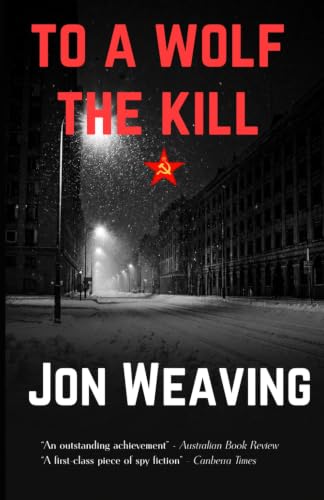
Welcome to Licence to Spill, Spybrary’s spy author Q&A series, where we put spy writers under the spotlight and ask them the questions spy thriller readers really want answered. This time it's thriller writer Jon Weaving, author of To A Wolf The Kill
“A first-class piece of spy fiction.”
— Canberra Times
- Take us back to the beginning — what was the book or author that made you think, “I want to write spy fiction”? For those new to your work, where do you recommend Spybrary readers start?
This has to be a two-part answer. Trevanian's 1972 thriller The Eiger Sanction was the first “spy” novel I remember reading as a young teen. I didn't know it at the time, but the MC (Jonathan Hemlock) was supposed to be a bit of a spoof of James Bond and the book, as a whole, a slightly comic take on Fleming's world of espionage. I didn't spot any of that… was completely taken up by the action, plot, exotic setting and baffling premise. It was all “story” and it made me want to write like that. I wrote my first novel when I was 16. It was all “story” and it was all rubbish.
Some years later, Martin Cruz Smith's Gorky Park showed me that “popular fiction” did not need to be cliched, predictable and written like a boy's own adventure. Cruz Smith's style was my first exposure to genre fiction told in a literary style. It was a revelation for me – I was hooked – and the art of leaving things unsaid, of relying on and trusting the reader to infer and be a part of the story rather than a mere recipient, became my holy grail.
I've spent the last 40 years committed to the writing philosophy that how something is said is every bit as important as what is being said, and that every single word has to prove its place and demand to be left on the page. Having this attitude to every single word in every single sentence has undoubtedly destroyed any chance of the word “prolific” ever being attached to me, but hey… I can honestly say that I've never once moved on to the next sentence without being completely satisfied with the last.

2. Walk us through your research process. Are you an “immerse yourself for months before writing” person? Do you visit and scope out locations?
I have tried to plan my writing before – and here I'm talking about complete books as well as individual chapters and scenes even. I've tried plotting and working out what I need to know before I start, but it's always been a disaster. Now I begin any piece of writing with nothing more than a vague idea of what it's about and what might/could happen.
Usually I have a single sentence stuck in my head that's impactful, meaningful and relevant to that idea. And then I write – to work out where it's going and what I need to know. Only then do I research – as I go and as needed. Sometimes that's as simple as a google search. Sometimes (as in the case of To A Wolf The Kill) it's six months of living in the pockets of Russian families because the writing that was demanding to be left on the page was also demanding that I understood “Russianness” in order for the writing to work and be believed. And that's the whole point of research… to make a piece of writing “believable”… to make it “work”.
Overall though, I'm much more interested in what something is and what it means to my characters, as opposed to what that something (a place maybe) might look like. So no, I rarely “scope out” locations.
3. Which era of espionage is your absolute favourite era to write in, and what makes it so irresistible?
Old-school espionage and character driven procedural investigation is my preference… though not necessarily Smiley's cold-war era. I think Mick Herron's Slough House series hits a great balance of threat, ordinary people in extraordinary situations, international intrigue and implication, humour and believability.

4. Which spy fiction book do you wish you had written yourself — and why?

Oh what a question! Top of my head? Tom Clancy's Hunt For Red October… because that debut novel gave us brilliant “techno” thriller detail, an intro to an enduring and not entirely unrelatable character in Jack Ryan, a great plot, tension, intrigue, doubt… and of course a Hollywood resolution… all of which helped guarantee Clancy a horde of loyal fans as well as fame and fortune. Bastard! And yes, I'm just jealous.
From an artistic and literary point of view, books I wished I'd written include Ondaatje's The English Patient, McEwan's The Innocent, and Le Carré's The Spy WHo Came In From The Cold.

5. What are you reading right now — and what's the one book in your TBR pile you keep meaning to get to but haven't yet?
Have been reading sci-fi and crime lately and currently reading Dick's Do Androids Dream Of Electric Sheep? (which is actually so far removed from Blade Runner as to be almost unrecognizable and The Expanse series by James S A Corey. My TBR pile is chockers with thrillers though and right now the one I'm most excited about getting to (but can't seem to) is Noble Reckoning by Andrew Bridgeman
6. Great spy fiction lives or dies on its antagonists. What makes a truly great spy fiction villain — and how do you approach writing yours?
I'm not a fan of comic-book caricature baddies. I want main villains that are businesslike and professional about what they're doing. The less important nasties… the “muscle”… can enjoy their work and be a little more personal about it if it helps the story. But that's a big “if”.
7. What's the one detail — a location, a piece of tradecraft, a historical fact — you uncovered during research that was so good you had to put it in the book?
I mentioned earlier about “learning Russianness” – needing to understand what it was like to live in late Soviet times. One manifestation of that was the projected “greatness” of anything “Soviet”, an example of which was the huge Stalinesque housing blocks. People were told (and expected to believe and loyally parrot back), the line that these monstrosities were bigger and better than anything the West could offer its people. Whereas they themselves parroted the reality of Soviet greatness by crumbling to the extent that residents would never come and go without first looking up to see if some great slab was about to break off and crush them. That was a metaphor for “living Soviet” that struck me, stuck with me and had to go in my book.
8. What is the strangest or most unexpected place/situation/person/story you have ever taken inspiration for a plot or character from?
Entirely by accident (I turned a little hire boat down the wrong marshy channel off Australia's south-eastern coast), I ended up on a tiny sand-spit of an island that didn't even appear on any map I had at the time. It was called Clonmel and it was so unexpected and seemingly out of place, I had to use it as the physical plot focal point in To A Wolf The Kill. The place itself was nothing, but what I imagined it could have been hiding became everything.
9. Which of your own characters would you most want running an operation you were part of — and which one would you absolutely not trust with your life?
Kirov (my protagonist) is an SID “investigator” – stoic, loyal and determined, as well as, tired, flawed, jaded and realistic (just to round off the cliche) – but I don't think he cares about the “big picture” so much as the minutiae he's been forced to step on and which now sits like dog shit on the sole of his shoe. I'd trust him to “care” about my life, but question his capacity to keep it safe. He's not the one to run an op. And his antagonist (Arutyunov) might wear a suit and think he's running things, but in reality he's nothing more than a barely polished turd of a man whose strings are being pulled every bit as much as Kirov's. So the only people from my book that I would trust to actually run an op would be the nameless/faceless CIA string-pullers… the ones trying to manipulate the old Soviet “wolves” back into power. They could certainly run an op… but if your worth wasn't unquestionably “high” you'd end up lasting five minutes.
9. Is there a spy fiction author working today who you think deserves far more attention than they're getting? And what's the one book of theirs you'd start with.
I don't spend time thinking about who's well-known and who isn't and I'm not a part of groups and organisations who might curate and discuss lists like that. I do however come across writers that are new to me and jot their names on a list with the intention (hope) of reading them and finding a gem. Right now that list is David McCloskey, Charles Beaumont, Jinwoo Park, Sam Guthrie and Catherine Merridale.

10. You're hosting the ultimate spy fiction dinner party — three guests, real or fictional, living or dead. Who's at the table?
Jackson Lamb – so my gaffs will go completely unnoticed, along with my farts and the fact I'll probably lick my knife. Mitchell Gant – I just want to hear everything about that op into the USSR and stealing that plane. Nancy Wake (the “White Mouse”) – did her spying under the gaze of the SS and managed to live to 99. Think of the stories!
11 What's next for you — and is there anything about your current project you can tease us with?
I mentioned sci-fi earlier. The book I'm currently writing (Stellar Slipper) is definitely still espionage/spy fiction and definitely NOT sci-fi schlock or even focussed on sci-fi at all. It is however, set 4000 years in the future. But it's just a backdrop, folks. I get to stretch my ideas on repercussions and risks from those that are small-scale and earth-bound, to the immense and galactically relevant. I get to introduce facets of behavior, attitude and social normality that hasn't come about yet. And I get to play with incredible toys, locales, scenes, possibilities and descriptions all without any of the research I'd need to do if I were setting this in our time and going for authenticity. I'm getting to create my own authenticity and concentrate entirely on the intrigue… the spying.
Jon Weaving Author Official Website
More Spy Author Interviews – Licence to Spill
Merle Nygate on Writing Spy Fiction
Crowley Clark on Writing Spy Fiction
David McCloskey on Writing Spy Fiction
Charles Beaumont on Writing
Simon Conway
Michael Frost Beckner on Writing Spy Fiction
Paul Vidich on Writing Spy Fiction
James Stejskal on Writing Spy Fiction
I.S. Berry on Writing Spy Fiction
Dan Fesperman on Writing Spy Fiction
Alex Gerlis on Writing Spy Fiction

Spy Book Reviewers Wanted.
Spybrary is an online magazine and espionage hub with one mission. To help fans of the spy genre discover great spy reads, revisit forgotten classics, and share insights with like-minded readers from around the world. Want to help us accomplish this important mission by writing spy book reviews and/or espionage-related articles and features? Details here.
Please note that any purchases made with an Amazon link earn Spybrary a small commission, which helps us pay our reviewers. Thank you for supporting Spybrary. The views expressed in our spy book reviews are those of the reviewer alone and do not necessarily reflect the views of Spybrary.