Licence to Spill is a Spybrary's Q&A series in which spy authors are grilled by spy thriller book fans.
Licence to Spill with author Simon Conway
Welcome to Licence to Spill, Spybrary’s spy author Q&A series, where we put spy writers under the spotlight and ask them the questions spy thriller readers really want answered. This time it's spy thriller author Simon Conway

Simon Conway answers his interrogator, Spybrary's Shane Whaley – August 2026. You can also listen to Simon discuss his latest book The British Agent on the Spybrary Spy Podcast.

- Take us back to the beginning — what was the book or author that made you think, “I want to write spy fiction”? For those new to your work, where do you recommend Spybrary readers start?
The best spy fiction offers double-crosses, deception, and murky morality. It’s a hard for me to pick any single author. I could reference several different works by Len Deighton, Graham Greene and John le Carré that have inspired me, but there is one classic non-fiction book I keep coming back to: The Gunpowder Plot by Antonia Fraser. It has the all the twists and turns you’d expect. In different ways it shaped A Loyal Spy, The Stranger and The British Agent.

The American spymaster Salisbury in The British Agent is based on the royal spymaster Robert Cecil, the Earl of Salisbury, who penetrated the 1605 plot to destroy parliament very early on but memorably said “let it ripen”. He calculated that by letting the plot run and swooping in to catch the conspirators red-handed with the explosives in place, he could use public outrage as a pretext to launch a witch-hunt against Catholics. The modern Salisbury in The British Agent views the 2023 plot to shoot down the president’s helicopter as a means of breaking up the network of extremist militias in the United States and their enablers in government and Congress

If you haven’t read my work before, I suggest that you start with The Stranger and I hope that you enjoy the “Dark Mirror” relationship between Jude Lyon and Guy Fowle. I know that some Spybrarians recommend The Agent Runner because, although it’s set in modern Afghanistan and Pakistan, it consciously uses so many of the tropes of a classic Cold War thriller. Unfortunately, it’s currently only published in the USA. I am hoping that my new publisher Penguin will put it out in the UK and elsewhere in due course.

2. Walk us through your research process. Are you an “immerse yourself for months before writing” person? Do you visit and scope out locations?
I enjoy the research, but I tend to do most of it while I’m writing, which often leads the story in unexpected directions. I like to walk the ground of the places that I write about. To taste the air and watch the sunrise. I’ve been fortunate that my career with HALO has taken me to so many of the places that I’ve written about, including Ukraine, Iraq, Syria, and Afghanistan.
I usually begin with an event or a place and start to build the characters and the plot around that. Eventually, the characters take control.
Two events in 2022 inspired The British Agent. The first happened shortly after my wife and I moved to Washington. We spent the first couple of months in an apartment in Georgetown that looked across the Potomac River to the office blocks on the Virginia side. One cold, bright morning I was sitting on the balcony when Marine One flew by, so close that it felt like I could have reached out and touched the helicopters. The second was a few months later in Ukraine. The Russians had recently been pushed back from Kyiv. In a field on the outskirts of an empty village, I saw the scattered wreckage of a Russian Alligator attack helicopter shot down with a surface-to-air missile. The book describes a route from one event to the other.
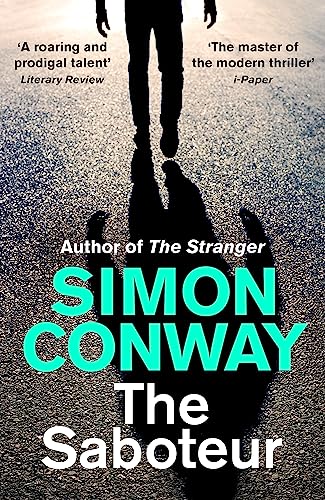
It was tough during Covid. I remember not being able to visit the Suffolk coast where the final chapters of The Saboteur are set. Instead, I was forced to rely on open-source information – ordnance survey maps, satellite images, birdwatcher’s diaries – to write about the Minsmere Marshes around the Sizewell nuclear power station.
I should qualify the above by saying that I don’t feel any obligation to be completely true to a location. When it comes to fiction, sometimes it’s necessary to make it up. The trick is to sprinkle enough truths (not Trump’s Truth Social ones) on the cake to make it edible.
3. Which era of espionage is your absolute favourite era to write in, and what makes it so irresistible?
I’ve always tried to make sense of the present through my writing. It may take a long time for the verdict of history to be written; in the meantime, a good story can cast a mirror on the present. It’s irresistible because it’s so consequential and the outcome is unknown.
In his book The Breaking of Nations published in 2003, the British diplomat Robert Cooper wrote “We may not be interested in chaos, but chaos is interested in us.” You can bookmark my books based on certain chaos-making events: post-Soviet opportunism, 9/11 and the forever wars, the nihilism of Islamic State, Gerasimov’s doctrine of hybrid war, the huckster Trump presidencies, and Putin’s folly in Ukraine.
Living in Washington DC for the last four years, I feel like I’ve had ring side seat to Imperial decline. A situation that is amplified by my wife’s job with the BBC. She literally watches or listens to everything that the President says. I couldn’t be here in DC and not write about it.
4. Which spy fiction book do you wish you had written yourself — and why?

I read a proof of The Night Manager back in 1993 and loved it. So that’s the one. It seems strange now, given all we’ve been through, but at the time there was talk of the spy thriller being redundant. Le Carre’s pivot to the post-Cold-War world with The Night Manager (arms trafficking), Our Game and Single & Single (post-Soviet turmoil in the Caucasus) and The Constant Gardener (Big Pharma) received a lacklustre reception from the critics in the UK. And yet those are the books of his that I like the best, perhaps because so much of their stories involve criminality and unfold in fall-between-the-cracks, ungoverned spaces. And in the case of The Night Manager, because Richard Onslow Roper is such a mesmerising villain.
5. What are you reading right now — and what's the one book in your TBR pile you keep meaning to get to but haven't yet?
I’ve just re-read The Cryptographer by Tobias Hill. It’s about an international financial disaster caused by the crash of a global electronic currency called Soft Gold. The central protagonist is Anna, an inspector from the Inland Revenue who is assigned to investigate a minor irregularity in the tax return of the mysterious Scottish Cryptographer John Law, the trillionaire software coder responsible for Soft Gold. Anna is persistent in her investigation. Pulling on what seems a tiny thread causes everything else to unravel. Tobias Hill died three years ago at the aged of 53 of brain cancer. It was great loss because he was such a talented writer.
I’ve have had the Scarlet Papers by Matthew Richardson in my TBR pile for a while now and my publisher keeps urging me to read it, so I had better get to it next.
6. Great spy fiction lives or dies on its antagonists. What makes a truly great spy fiction villain — and how do you approach writing yours?
I enjoy the idea of a “Dark Mirror”, a villain who shares the same skills as the hero, revealing what he or she could become if they lost their way. They must be smart, of course, capable of anticipating and outmaneuvering their opponents. And finally, they can’t just be evil for the sake of it. There must be a reason.
The conspirators in The British Agent are victims as much as they are villains, subject to childhood abuse and prey to the seductive dynamics of the internet. They are conspiracy theorists, white supremacists, and Neo Nazi street-brawlers, sharing a fetish-like obsession with civil war.
It should probably be a red flag, but I like writing villains. My imagination steers that way. I was very happy when our own Tim Shipman described Guy Fowle as one of the greatest villains in 21st Century spy literature. Writing Fowle on the page made me want to wash my eyes.
7. What's the one detail — a location, a piece of tradecraft, a historical fact — you uncovered during research that was so good you had to put it in the book?
When the ITV correspondent Robert Moore told me about a lawless swamp west of Daytona Beach in Florida that the police suspect of containing extremist training camps and won’t enter because of the risk of ambush, I had to include it as the alligator-infested Wampee in The British Agent. And it was Robert who coined the term “abuse and algorithms” to describe the influences that shaped so many of the January Sixth insurrectionists.
8. What is the strangest or most unexpected place/situation/person/story you have ever taken inspiration for a plot or character from?
There have been so many. I’m lucky that way. I once spent a night in the Sahara with fighters from the Polisario Front hunting for migrants who had been ejected by the Moroccans through a minefield into the desert with a few tins of sardines and very little water. Some of them were in a grim state by the time we found them. That made its way into A Loyal Spy. One of the migrants from West Africa refused to be repatriated and remained in the desert, working as a mechanic in a Mad Max style outpost in the “liberated zone”. I used to let him call home on my satphone.
9. Which of your own characters would you most want running an operation you were part of — and which one would you absolutely not trust with your life?
It would have to be Jude Lyon to run the operation, but Chuff and Natasha from The British Agent to execute it.
I wouldn’t trust any of the authority figures in my books, from A Loyal Spy’s Monteith to The Stranger’s Queen Bee, to The British Agent’s Salisbury to keep me alive. Salisbury is fond of a saying of Thomas Jefferson: “The tree of liberty must be refreshed from time to time with the blood of patriots and tyrants. It is its natural manure.” Not exactly reassuring.
10. Is there a spy fiction author working today who you think deserves far more attention than they're getting? And what's the one book of theirs you'd start with.
I’d like to give a shout out to Alex Carr’s novels the Edgar-winning The Prince of Bagram Prison and An Accidental American. Alex Carr is a pseudonym used by the crime writer Jenny Siler whose other work I haven’t read yet. There are echoes of Graham Greene in her writing.

The Prince of Bagram Prison takes the reader from suburbs of northern Virginia to the interrogation centers of Afghanistan's Bagram Prison to Madrid’s red-light district to Casablanca's slums as U.S. Army intelligence reservist Kat Caldwell searches for a young Moroccan boy with supposed ties to terrorists.
11. You're hosting the ultimate spy fiction dinner party — three guests, real or fictional, living or dead. Who's at the table?
The desert explorer Count Lazlo Almasy who smuggled German agents across the Libyan desert into Egypt for the Abwehr in 1942, the 14-Intelligence Company officer Robert Nairac who was abducted by the Provisional IRA in 1977, and Sir Alex Younger, the former head of Mi6, who was one of the first to warn that cyber-attacks, propaganda and subversion by Russia pose a threat to UK democracy. I’ll rely upon Alex to compere the evening.
I think the fictional Almasy of The English Patient whose motivation for revenge on the British is the death of his English lover, Katharine Clifton, rather than the real, historical figure. He'll tell us tales of the Great Sand Sea and the Cave of Swimmers in the Gilf Kebir. Robert Nairac had a great singing voice, and he knew all the rebel songs. He sang The Broad Black Brimmer in the Three Steps pub in South Armagh on the night he disappeared. He’ll sing for us and maybe he’ll tell us where he’s buried. It’s a little-known fact that Alex Younger worked as a volunteer for HALO before joining MI6. He was very charming man, and I think he’d keep the conversation going.
We’d drink Pauillac and eat rare roast beef followed by an oozing slab of Gorgonzola.
12.. What's next for you — and is there anything about your current project you can tease us with?
I’m writing a book about foreign meddling in the British parliament. Russians, Chinese and American intelligence operatives view for influence over a rising populist leader who has his sights set on Downing Street. Working against him is a secretive British organisation The Glamis Group that was established after the Second World War by King George VI. The King was worried that Westminster might prove as vulnerable as the Reichstag had to a hostile takeover. After all, it took Hitler only fifty-three days to dismantle democracy in Germany. Privately funded and shielded from the scrutiny of the Joint Intelligence Committee, the Glamis Group intervenes where the security services cannot.
For more – check out Simon Conway Official Website.
More Spy Author Interviews – Licence to Spill
Michael Frost Beckner on Writing Spy Fiction
Paul Vidich on Writing Spy Fiction
James Stejskal on Writing Spy Fiction
I.S. Berry on Writing Spy Fiction
Dan Fesperman on Writing Spy Fiction
Alex Gerlis on Writing Spy Fiction

Spy Book Reviewers Wanted.
Spybrary is an online magazine and espionage with one mission. To help fans of the spy genre discover great spy reads, revisit forgotten classics, and share insights with like-minded readers from around the world. Want to help us accomplish this important mission by writing spy book reviews and/or espionage-related articles and features? Details here.
Please note that any purchases made with an Amazon link earn Spybrary a small commission, which helps us pay our reviewers. Thank you for supporting Spybrary. The views expressed in our spy book reviews are those of the reviewer alone and do not necessarily reflect the views of Spybrary.