William Boyd on why are spy novels so addictive — and what makes a great espionage novel.
Why are spy novels so addictive — and what separates a truly great espionage novel from a conventional thriller?
Author William Boyd joins Ollie Webb Carter (History Book Club Podcast) on Spybrary for a fascinating spoiler free conversation about spy fiction, John le Carré, Cold War espionage and the creation of his reluctant spy, Gabriel Dax.

Why are spy novels so addictive?
For William Boyd, the answer lies in uncertainty.
The best espionage fiction does not simply ask the reader to follow a plot. It asks them to participate in it — to question motives, second-guess characters and constantly wonder who can be trusted.
That philosophy sits at the heart of Boyd’s Gabriel Dax novels, which follow a travel writer drawn ever deeper into the murky world of Cold War intelligence.

In conversation with Ollie Webb Carter for Spybrary, Boyd discussed the enduring appeal of spy fiction, the influence of John le Carré, the real intelligence figures who helped inspire his characters, the pleasures of writing about analogue espionage and the unlikely origins of Gabriel Dax himself.
He also made one thing clear: although Cold Sunset completes the initial trilogy, Gabriel Dax is not necessarily finished.

Read Spybrary's spoiler free review of WIlliam Boyd's The Predicament.
The Appeal of Spy Fiction
Boyd believes complexity is one of the defining characteristics of a successful spy novel.
The genre, he argues, works best when readers are not entirely sure what is happening — and have to work alongside the protagonist to piece together the truth.
“The reason I love reading spy novels is that you’re trying to figure out what’s going on,” he says.
That sense of uncertainty is central to the Gabriel Dax novels. Everything is filtered through Gabriel’s perspective, yet Gabriel himself does not always understand what is happening around him.
Sometimes the reader may even be ahead of him.
For Boyd, that creates the distinctive pleasure of espionage fiction: the suspicion that another layer of the story is always waiting to be uncovered.
Mystery, Betrayal and the Double Bluff
The familiar ingredients of spy fiction are all there: betrayal, false identities, Russians, divided loyalties and deception.
But Boyd sees those elements as part of something larger.
What really matters is the “double and triple bluff” — the feeling that every apparent truth may conceal another.
A reader should find themselves asking the same questions as the spy: Who can I trust? Should I accept this mission? What is really going on?
It is this intellectual involvement, rather than simply action or suspense, that Boyd finds most beguiling.
The Shadow of John le Carré
No discussion of modern British spy fiction can travel very far without encountering John le Carré.
Boyd has written extensively about le Carré and considers The Spy Who Came in from the Cold his masterwork.
He also points to the wider literary tradition surrounding espionage fiction — a genre that has repeatedly attracted writers who would never have regarded themselves simply as “genre novelists.”
Boyd cites authors including Graham Greene, Muriel Spark, Elizabeth Bowen, John Banville and Sebastian Faulks as part of that lineage.
Spy fiction, in other words, has always occupied an unusual position: capable of delivering the pleasures of a thriller while also exploring character, morality, politics and betrayal.
Boyd sees himself as part of that tradition.
His own description of the Gabriel Dax novels is revealing: “spy novels with extras.”
How Gabriel Dax Became a Spy
Gabriel Dax did not begin as a professional intelligence officer.
He is a travel writer who gradually finds himself drawn into espionage — initially as something approaching a useful outsider.
Across the novels, however, that changes.
By the time of Cold Sunset, Gabriel has experienced danger, surveillance and violence. His instincts have sharpened. His tradecraft has improved. He is learning how to recognise threats and how to survive them.
Boyd acknowledges that Gabriel is becoming increasingly accomplished.
His life as a travel writer is slowly being overtaken by his life as an intelligence operative.
“He’s discovered he has a talent for it,” Boyd says.
That evolution also gives Boyd somewhere to take the character in future novels.
Faith Green and the Real Woman Behind the Fiction
One of the most intriguing figures in the series is Faith Green, Gabriel’s enigmatic MI6 handler.
Cool, manipulative and difficult to read, Faith exerts an extraordinary hold over Gabriel.
Boyd reveals that the starting point for the character was a real intelligence officer: Daphne Park.
Park had a distinguished career in British intelligence and served in postings including Moscow and the Congo before later becoming Principal of Somerville College, Oxford.
Boyd actually met her there.
At the time, however, he had little idea of the remarkable intelligence career behind the woman he knew simply as the college principal.
Only years later, while researching the Lumumba assassination, did Boyd encounter Park again in the historical record.
That discovery helped inspire Faith Green.
Spy Handler, Puppet Mistress, Lover
Faith’s relationship with Gabriel is deliberately complicated.
She recruits him, manipulates him and withholds much of the truth about the missions he undertakes.
Gabriel describes himself as a marionette and Faith as the puppet mistress pulling the strings.
But their relationship is not merely professional.
They also become lovers, breaking one of the obvious rules of intelligence work and creating an emotional dependency that complicates Gabriel’s judgement.
Boyd describes this strand of the novels as a strange love story running alongside the espionage plot.
And he offers a suitably ominous prediction for its future:
“I suspect it can only get worse.”
Why the 1960s Are Perfect for Spy Fiction
Boyd clearly relishes writing about the Cold War.
Part of the attraction is historical. The 1960s provide an extraordinary backdrop of ideological confrontation, intelligence operations, political assassinations and shifting alliances.
But there is also a practical advantage for a novelist.
Espionage was analogue.
There were no mobile phones, no GPS satellites and no internet. If a spy needed to make a telephone call, he had to find a phone box.
That immediately changes the mechanics of suspense.
Modern intelligence, Boyd suggests, is dominated increasingly by electronic surveillance and the processing of vast quantities of information.
The Cold War spy, by contrast, often had to operate physically in the field.
For a novelist, that world offers enormous possibilities.
The Old-Boy Network of British Intelligence
The world Boyd writes about was also shaped by class.
British intelligence in the mid-20th century was heavily populated by men from public schools and Oxbridge.
The Cambridge Five emerged directly from that environment.
Guy Burgess, Kim Philby and their contemporaries came from the same social world as many of the people supposed to detect them.
That familiarity, Boyd argues, could become a weakness.
Everyone spoke the same language. They attended the same institutions, belonged to the same clubs and understood the same social codes.
The idea that someone from within that world might be betraying Britain could therefore be surprisingly difficult for colleagues to accept.
Boyd sees that complacency as one reason figures such as Philby were able to survive for so long inside the intelligence establishment.
JFK, Conspiracy and the Freedom of Fiction
Real historical events run throughout the Gabriel Dax novels.
In The Predicament, Boyd brings the Kennedy assassination into the fictional world of his characters.
It is a subject on which he has strong views.
Boyd describes himself unequivocally as a conspiracy theorist when it comes to JFK and says his extensive reading has convinced him that Lee Harvey Oswald did not act alone.
The historical uncertainty surrounding the assassination is also ideal territory for fiction.
Boyd can take genuine events, unresolved questions and competing theories, then weave Gabriel Dax through them.
That freedom is one of the great advantages of the novelist.
He is not writing reportage or conventional history.
He can imagine what might have happened in the spaces where certainty disappears.
Espionage, Empire and Regime Change
Boyd’s Cold War is not simply a world of trench coats and dead drops.
It is also a world of geopolitics.
The novels touch on Western interventions in countries including the Congo and Guatemala, allowing Boyd to explore the role played by intelligence agencies during the Cold War.
The assassination of Patrice Lumumba forms an important historical backdrop to Gabriel’s Moon.
Boyd is fascinated by the contrast between the rhetoric of democracy and the ruthless reality of great-power competition.
These events give the novels their larger historical canvas.
Gabriel Dax may be trying to understand the immediate mission in front of him, but behind that mission sit governments, intelligence agencies, corporations and ideological conflicts far beyond his control.
The Television Series That Became Gabriel Dax
Perhaps the most unexpected part of Gabriel Dax’s origin story begins not in publishing, but in television.
After Boyd’s novel Restless became a successful BBC miniseries, he was invited to develop a Cold War spy series.
He wrote a pilot, attended numerous development meetings and carried out extensive research.
The project never happened.
Boyd says he eventually became convinced that the proposed series was never really going to be made.
But the work was not wasted.
Years later, after finishing The Romantic, he returned to the research and ideas he had accumulated during the television project.
From that material emerged a new character — Gabriel Dax — and a new series of novels.
What had been a professional disappointment became creative raw material.
“Nothing is wasted in a writer’s life,” Boyd says. “Everything can be recycled.”
The Last Laugh
Boyd speaks candidly about the frustrations of film and television.
Projects collapse. Promises are broken. People change their minds.
Despite having enjoyed considerable success as a screenwriter, he says professional disappointments remain a regular part of the business.
The lesson seems to be resilience.
A writer stores everything away.
Research, abandoned scripts, bad meetings and failed projects can all become useful later.
In the case of Gabriel Dax, an idea that failed in one medium ultimately flourished in another.
Boyd even allows himself a note of satisfaction: “Maybe I’ve got the last laugh.”
Is Cold Sunset Really the End of Gabriel Dax?
Readers reaching the end of Cold Sunset should not assume they have seen the last of Gabriel Dax.
Boyd deliberately leaves the door open.
The story has only reached 1964.
There is, as he points out, “a lot of the Cold War left to run.”
His next book will not be a Gabriel Dax novel. Boyd plans instead to return to what he calls one of his “whole life novels.”
But after that?
He expects Gabriel to return.
Boyd already has ideas about historical situations into which he might drop his reluctant spy.
And that may be the most tantalising prospect of all.
Gabriel Dax began as a travel writer who stumbled into espionage.
Three novels later, he is increasingly becoming a spy.
The Cold War, meanwhile, has barely begun.
If you love John le Carré, Graham Greene, Cold War history, MI6, CIA stories and intelligent spy fiction, this is one for you.
Subscribe to Spybrary for more conversations with the world’s leading spy writers, historians and intelligence experts.
About Spybrary
Spybrary is the home of spy fiction — bringing together spy writers, historians, intelligence professionals and an international community of espionage readers.
Join the Spybrary Community
What do you make of William Boyd's spy novels?
Why do you love spy fiction?
Let us know in our online Spybrary Community
Links
WIlliam Boyd Official Site
William Boyd Novels
History Book Club Podcast with Oliver Webb-Carter
The Top 125 Spy Authors Ranked and Rated by Tim Shipman
Join the Spybrary Community
Support Spybrary
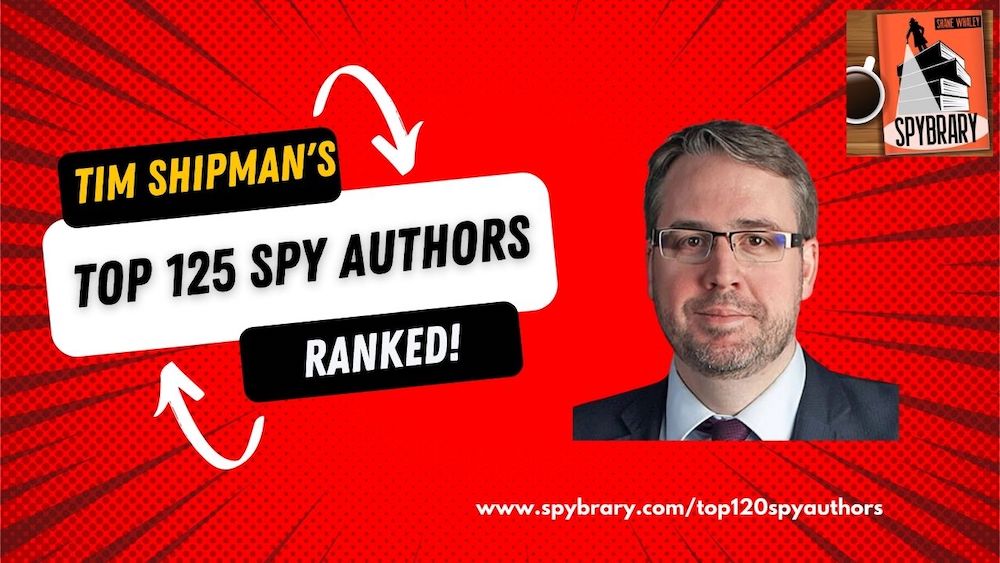
Did you know that one of the UK's top journalists Tim Shipman also has a passion for espionage novels? And that he has meticulously curated a compendium of his favorite 125 spy authors for the Spybrary Podcast and Community, all carefully ranked with suggestions on which book to start with from each spy author.
Grab your copy of this invaluable dossier and as a bonus, your enlistment ushers you into the monthly Spybrary Briefing, where we divulge imminent and upcoming spy book releases.